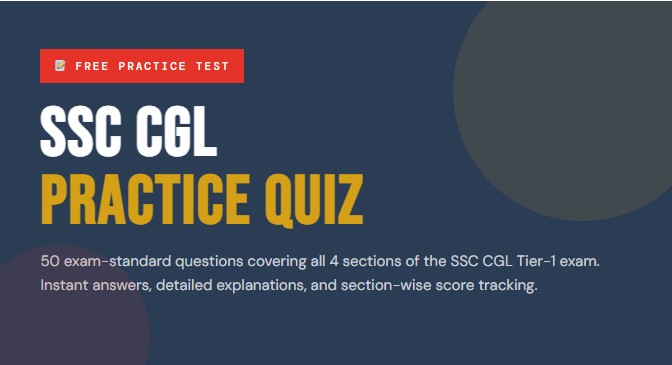
50 exam-standard questions covering all 4 sections of the SSC CGL Tier-1 exam. Instant answers, detailed explanations, and section-wise score tracking.
General Intelligence & Reasoning
Verbal and non-verbal reasoning — 13 questions · 26 marks
Exam Tip — Reasoning
Series, analogies, and coding-decoding together account for ~35% of reasoning questions. Always verify the pattern from at least two examples before selecting your answer.
A Book is stored and displayed in a Library. Similarly, a Painting is stored and displayed in a Gallery. A museum is broader (includes artefacts), while a gallery is specific to art — exactly as a library is specific to books.
Each letter is replaced by its position in the alphabet: W=23, A=1, L=12, K=11. Verify with ROAD: R=18? — wait, here R=17, O=15, A=1, D=4. Note R is 18th but coded as 17 (shifted by −1). So: W(23)→23, A(1)→1, L(12)→12, K(11)→11. The shift does not apply consistently to vowels vs consonants — the key is the standard alphabetical position giving 23-1-12-11.
The pattern: each term is (previous × 2) + 2.
3 × 2 + 2 = 8 → 8 × 2 + 2 = 18 → 18 × 2 + 2 = 38 → 38 × 2 + 2 = 78 → 78 × 2 + 2 = 158.
Start → 10 km North → turn right (now facing East) → 5 km East → turn right (now facing South) → 10 km South (back to original latitude) → turn left (now facing East) → 3 km East. Net displacement: 5 + 3 = 8 km East from starting point. Direction = East.
Violin, Guitar, Sitar, and Cello are all string instruments (chordophones). The Flute is a wind instrument (aerophone). Hence, Flute is the odd one out.
The man's grandfather's only son = the man's father. So the woman is the daughter of the man's father = the man's sister.
From the premises, we cannot definitively say some roses are red (I) or no rose is red (II). These are complementary conclusions — exactly one must be true, but we cannot determine which. In syllogism, when two conclusions are complementary, the answer is "Either I or II follows."
First letters: A, B, C, D → next is E. Second letters: Z, Y, X, W → next is V. Therefore the answer is EV.
Position from right = Total − Position from left + 1 = 40 − 15 + 1 = 26.
For mirror image of a clock, subtract the given time from 11:60. 11:60 − 8:30 = 3:30.
Using: n(A∪B) = n(A) + n(B) − n(A∩B)
70 = 37 + 52 − n(A∩B) → n(A∩B) = 89 − 70 = 19.
A is B's brother → A and B share the same mother C. D is the father of C. Therefore, D is the father of B's mother = B's Maternal Grandfather.
January 1, 2025 was a Wednesday. 2025 is not a leap year (365 days = 52 weeks + 1 day). Adding 1 odd day to Wednesday → Thursday. This is consistent with actual calendar fact: January 1, 2026 fell on a Thursday.
Quantitative Aptitude
Arithmetic, algebra, geometry & data interpretation — 13 questions · 26 marks
Exam Tip — Quantitative Aptitude
Percentage, Profit & Loss, Time-Work, and Geometry account for ~50% of quant questions. Learn shortcut formulas for percentage change, simple interest, and ratio comparisons to save 20–30 seconds per question.
Let CP = 100. MP = 125. After 10% discount: SP = 125 × 0.90 = 112.5.
Profit% = (112.5 − 100)/100 × 100 = 12.5%.
SI = 6500 − 5000 = ₹1,500. Rate = (SI × 100) / (P × T) = (1500 × 100) / (5000 × 3) = 150000/15000 = 10%.
Combined rate = 1/12 + 1/18 = 3/36 + 2/36 = 5/36 of work per day.
Days = 36/5 = 7.2 days.
Area of square = d²/2 = (10√2)²/2 = 200/2 = 100 cm².
Let numbers = 3x, 5x. (3x+9)/(5x+9) = 3/4 → 4(3x+9) = 3(5x+9) → 12x+36 = 15x+27 → 3x = 9 → x = 3. Smaller number = 3 × 3 = 9.
Speed = 200/10 = 20 m/s. Convert: 20 × 18/5 = 72 km/h.
For 5 consecutive odd numbers, the average equals the middle (3rd) number. Middle = 25. Numbers: 21, 23, 25, 27, 29. Largest = 29.
(x + 1/x)² = x² + 2 + 1/x² → 25 = x² + 2 + 1/x² → x² + 1/x² = 25 − 2 = 23.
CSA = 2πrh = 2 × (22/7) × 7 × 10 = 2 × 22 × 10 = 440 cm².
Pattern of 2ⁿ mod 7: 2¹=2, 2²=4, 2³=1, 2⁴=2, ... cycle of 3 (2,4,1). 100 ÷ 3 = 33 remainder 1. So 2¹⁰⁰ has same remainder as 2¹ = 2.
sin30° = 1/2 → sin²30° = 1/4. cos60° = 1/2 → cos²60° = 1/4. tan45° = 1 → tan²45° = 1. Sum = 1/4 + 1/4 + 1 = 1.5.
36 = 2²×3², 48 = 2⁴×3, 60 = 2²×3×5. HCF = 2² × 3 = 12.
Percentage = (Sector angle / 360°) × 100 = (72/360) × 100 = 20%.
English Language & Comprehension
Grammar, vocabulary, error detection & comprehension — 12 questions · 24 marks
Exam Tip — English
Error spotting, fill in the blanks, and synonyms/antonyms together contribute ~55% of English marks. Focus on subject-verb agreement, tense rules, and commonly tested vocabulary from previous SSC papers.
Eloquent means fluent and persuasive in speaking or writing. Articulate means able to speak clearly and express ideas well — the closest synonym. Silent and Vague are antonyms; Clumsy is unrelated.
Tenacious means holding firm, persistent. Its antonym is Irresolute — uncertain, lacking resolve. Persistent, Resolute, and Stubborn are synonyms of Tenacious.
"She along with her friends (A) / were going (B) / to the market (C) / yesterday. (D)"
When the subject is connected by "along with," the verb agrees with the primary subject ("She" — singular). Correct sentence: "She along with her friends was going to the market yesterday."
A landmark discovery means one of great significance or a turning point. Trivial means minor; obsolete means outdated; redundant means unnecessary — none fits the positive, significant context.
"To burn the midnight oil" is an idiom meaning to work or study late into the night, derived from the era when oil lamps were used and burning oil at midnight indicated extended late-night work.
Active: Subject + is/am/are + V-ing + Object. Passive: Object + is/am/are + being + V3 + by + Subject. "is teaching" → "are being taught." Tense = Present Continuous.
A Stoic is one who endures pain or hardship without complaint and is indifferent to pleasure or pain. Epicurean = devoted to pleasure; Hedonist = devoted to pleasure-seeking; Cynic = one who distrusts people's motives.
In "Neither…nor" constructions, the verb agrees with the subject closer to it. "Employees" is plural → verb must be were (past plural). "was" is incorrect here.
"Stay abreast of" is an idiomatic phrase meaning to remain informed or up-to-date with something. Alienated, indifferent, and oblivious all convey the opposite of the positive, informed context here.
The correct spelling is Bureaucracy — a system of government in which most decisions are made by state officials. It comes from French "bureau" (desk/office) + Greek "kratos" (rule/power). All other options are misspellings.
In reported speech, "said" (past) → present continuous "am going" shifts to past continuous "was going." "I" changes to "he." Reporting verb "said" → no change (no "to" since there's no object).
Correct sentence: "The children played happily in the park." Structure: Subject (P) + Verb (Q) + Adverb of Manner (S) + Adverb of Place (R).
General Awareness
History, Geography, Economy, Polity, Science & Current Affairs — 12 questions · 24 marks
Exam Tip — General Awareness
Current affairs (5–7 Qs), History (4–5 Qs), and Static GK (Science + Geography, 6–8 Qs) are the highest-yielding areas. Revise NCERT Class 6–10 Social Science + 2 months of current affairs before the exam.
The Battle of Plassey was fought on June 23, 1757, between the British East India Company led by Robert Clive and the Nawab of Bengal, Siraj-ud-Daulah, who was betrayed by his commander Mir Jafar. This battle established British political supremacy in India.
Article 352 — National Emergency (war, external aggression, or armed rebellion). Article 356 — President's Rule (State Emergency). Article 360 — Financial Emergency. These three emergency provisions are important for polity questions in SSC CGL.
The Ganga (Ganges) is the longest river in India at approximately 2,525 km. It originates from Gangotri Glacier in Uttarakhand and drains into the Bay of Bengal. The Indus is longer overall but mostly flows through Pakistan. The Godavari is the longest river of Peninsular India.
The Second Five-Year Plan (1956–61) was based on the Mahalanobis model (P.C. Mahalanobis) and prioritised rapid industrialisation with a focus on heavy and basic industries — steel, coal, and machine tools. This became the foundation of India's Public Sector Undertaking (PSU) growth.
The Iris is the coloured part of the eye that regulates the size of the pupil, thereby controlling the amount of light that enters the eye. The Cornea is the transparent outer layer; the Retina receives images; the Lens focuses light.
The SI unit of electric current is the Ampere (A). Volt is the unit of electric potential (voltage); Watt is the unit of power; Ohm is the unit of electrical resistance. All four are fundamental units in electricity — a common SSC question type.
NaCl (Sodium Chloride) is the chemical formula of common table salt. KCl = Potassium Chloride (also a salt but not table salt); CaCO₃ = Calcium Carbonate (limestone/chalk); Na₂SO₄ = Sodium Sulphate.
India's first Vande Bharat Sleeper Train was launched in January 2026 on the Howrah (Kolkata) – Guwahati route. This marked a major upgrade to India's overnight rail travel infrastructure with modern amenities, semi-high speed performance, and improved passenger comfort.
Dr. B.R. Ambedkar is known as the "Father of the Indian Constitution." He was the Chairman of the Drafting Committee of the Constituent Assembly and is widely credited for shaping the Constitution's structure, fundamental rights, and directive principles. Rajendra Prasad was the President of the Constituent Assembly.
The Bharat Ratna was instituted on January 2, 1954. The first recipients were C. Rajagopalachari (Rajaji), Dr. S. Radhakrishnan, and Dr. C.V. Raman. It is awarded for exceptional service towards the advancement of art, literature, science, or public service.
The Ramsar Convention (1971), formally the Convention on Wetlands of International Importance, was adopted in Ramsar, Iran. It is a global framework for the conservation and wise use of wetlands. India has 89 Ramsar sites (as of 2025) — the highest in Asia.
At any point during play: 11 fielders (including the bowler and wicketkeeper) + 2 batters (striker + non-striker) = 13 players on the field simultaneously. The batting team has 11 players overall but only 2 are on the pitch at any time.
Your Score
Here's how you performed across all four sections
Reasoning
Maths
English
Gen. Awareness
SSC CGL Tier-1 Exam Pattern at a Glance
| Section | Questions | Maximum Marks | Time |
|---|---|---|---|
| General Intelligence & Reasoning | 25 | 50 | 60 Minutes (Total) |
| General Awareness | 25 | 50 | |
| Quantitative Aptitude | 25 | 50 | |
| English Language & Comprehension | 25 | 50 | |
| Total | 100 | 200 | — |
⚠️ Negative marking: 0.50 marks deducted for each incorrect answer. Unattempted questions carry no penalty.
How to Crack SSC CGL — Quick Strategy Guide
| Section | Target Score | Highest-Weight Topics | Best Resource |
|---|---|---|---|
| Reasoning | 40+/50 | Series, Analogy, Coding, Blood Relations | R.S. Aggarwal Verbal & Non-Verbal |
| Quantitative Aptitude | 38+/50 | %age, Geometry, Time-Work, Algebra | Rakesh Yadav Class Notes |
| English | 40+/50 | Error Spotting, Synonyms/Antonyms, FIBs | SP Bakshi / Plinth to Paramount |
| General Awareness | 38+/50 | Current Affairs, History, Static GK | Lucent's GK + Monthly CA Digest |