Notice Writing for Class 8 – Format, Examples & Tips to Score Full Marks
Are you struggling with notice writing for Class 8 in English? You are not alone. Thousands of students find it confusing to remember the right format, the correct tone, and exactly what to include. The good news? Once you understand the structure, notice writing becomes one of the easiest ways to score full marks in your English exam.
In this complete guide, you will learn everything — from the standard format and solved examples to common mistakes and frequently asked questions. By the end, you will be able to write a perfect notice confidently.
Let’s get started!
What Is Notice Writing?
A notice is a formal written document used to convey important information, announcements, or instructions to a specific group of people. It is short, precise, and always written in formal English.
Notices are commonly displayed on school bulletin boards, office notice boards, housing society boards, and public places. The key purpose of a notice is to reach as many people as possible with clear and factual information.
When Is a Notice Used?
- To announce an upcoming event (sports day, annual function, cultural fest)
- To inform about a meeting or assembly
- To report lost or found items
- To issue warnings or reminders
- To share important changes like holiday, schedule, or fee deadlines
Why Is Notice Writing Important for Class 8 Students?
Notice writing for Class 8 in English carries significant weightage in both CBSE and ICSE board exams. Here is why you should master it right now:
- Marks matter: A single notice question can carry 5 to 8 marks in your English paper.
- Easy to score: Unlike essays or stories, notice writing follows a fixed format — learn the format once and you can attempt any notice question confidently.
- Real-life skill: Notice writing is used in real life — in schools, offices, apartments, and communities.
- Appears every year: It is a regular feature in board exam question papers and school tests.
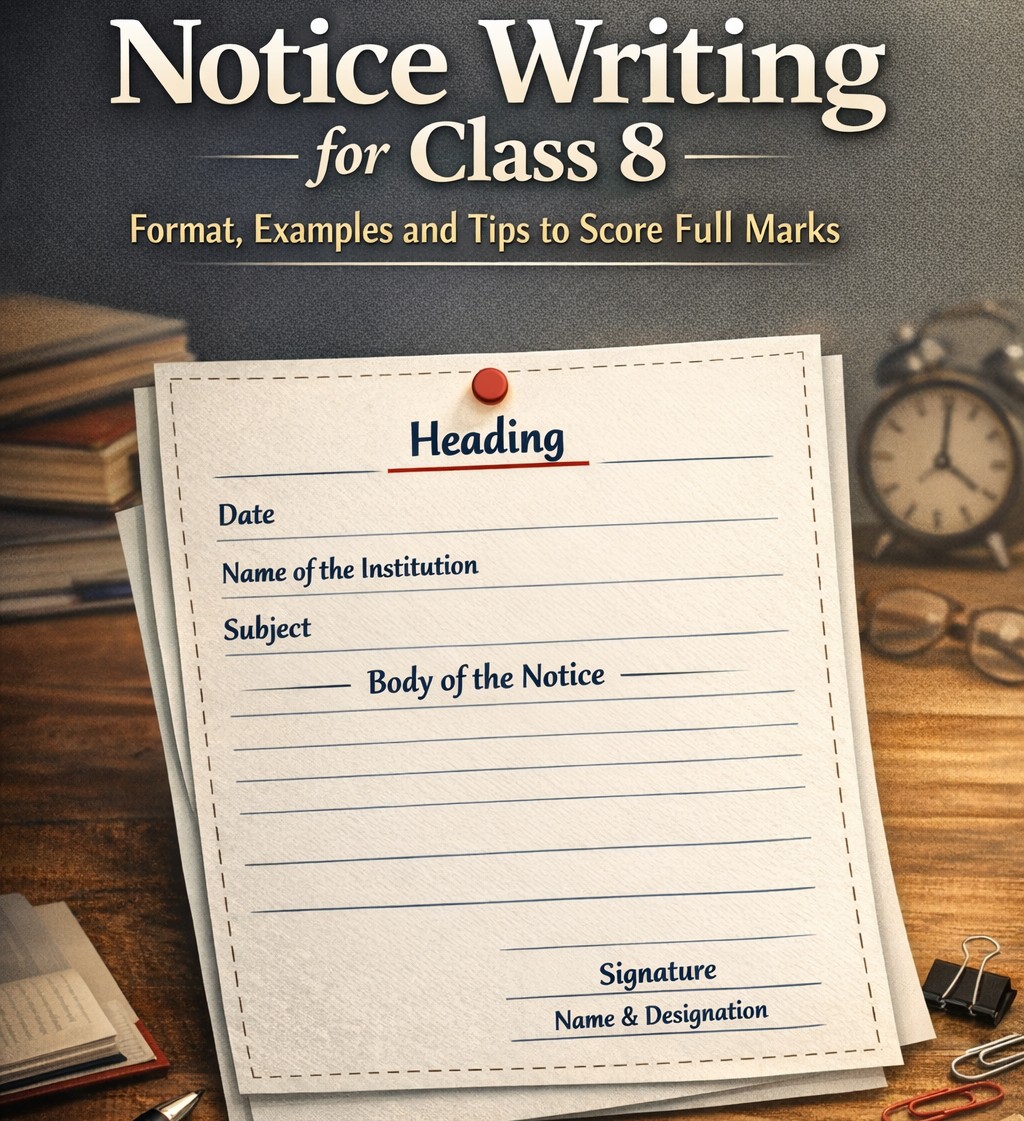
Standard Format of Notice Writing for Class 8 in English
Every notice follows a fixed structure. Stick to this format and you will never lose marks for presentation.
| Part | What to Write | Position |
|---|---|---|
| Name of Organisation | School name, institution, or society name | Top Centre |
| NOTICE | The word “NOTICE” in bold / capitals | Centre, below organisation name |
| Date | Date of issuing the notice | Left side |
| Heading / Title | Short, catchy title describing the notice topic | Centre, underlined |
| Body | Details — What, Who, When, Where, Why, How | Left-aligned paragraph |
| Signature | Signature of the issuing authority | Left or Right side |
| Name & Designation | Full name and designation/role | Below signature |
💡 Pro Tip: Always draw a box around the entire notice in your answer sheet. It makes the notice look neat, professional, and complete — and can earn you presentation marks.
Visual Layout of a Notice
          [Name of School / Organisation]
                      NOTICE

  Date: ___________


              [Heading / Title of Notice]


  [Body of the notice — 3 to 5 sentences covering
   all important details: what, who, when, where,
   why, and any additional instructions]

  [Signature]
  [Full Name]
  [Designation]
Solved Examples of Notice Writing for Class 8 in English
The best way to understand notice writing is to read well-written examples. Study each one carefully and observe how the format is applied.
Example 1 – Annual Sports Day Notice
              Sunrise Public School, Delhi
                        NOTICE

  Date: 10 January 2025


                  Annual Sports Day


  This is to inform all students that the Annual
  Sports Day will be held on 25 January 2025 at
  9:00 AM on the school sports ground. All students
  participating in track and field events must report
  by 8:30 AM in their sports uniform. Spectators are
  requested to remain in the designated gallery area.
  Parents are warmly invited to attend.

  Ravi Kumar
  Sports In-charge
  Sunrise Public School
Example 2 – Lost and Found Notice
           Delhi Public School, Bengaluru
                        NOTICE

  Date: 14 February 2025


             Lost – School ID Card


  I, Ananya Sharma, a student of Class 8-A, have
  lost my school identity card somewhere on the
  school premises on 13 February 2025. The card
  bears my name, photograph, and roll number 14.
  Whosoever finds it is requested to kindly hand it
  over to the school office or contact me directly.
  I shall be grateful for your help.

  Ananya Sharma
  Class 8-A, Roll No. 14
Example 3 – Student Council Meeting Notice
             Modern Academy, Pune
                        NOTICE

  Date: 3 March 2025


            Student Council Meeting


  All members of the Student Council are hereby
  informed that an urgent meeting will be held on
  7 March 2025 at 1:00 PM in the school conference
  room to discuss the arrangements for the upcoming
  Annual Day celebrations. Attendance is compulsory.
  Members are requested to come prepared with their
  suggestions and ideas.

  Meera Joshi
  Head Girl
  Modern Academy
Example 4 – Book Fair Notice
              Greenfield High School, Jaipur
                        NOTICE

  Date: 20 March 2025


                     School Book Fair


  Students are delighted to announce that a Book Fair
  will be organised in the school auditorium from
  28 March to 30 March 2025, from 10:00 AM to
  4:00 PM daily. Books on various subjects including
  fiction, science, history, and comics will be
  available at discounted prices. Students wishing to
  participate should register with their class
  teacher by 25 March 2025.

  Anjali Singh
  Cultural Secretary
  Greenfield High School
Example 5 – Holiday Notice from School Principal
              St. Mary's School, Mumbai
                        NOTICE

  Date: 5 April 2025


                   School Holiday Notice


  This is to inform all students, teachers, and staff
  that the school will remain closed on 10 April 2025
  on account of local civic elections. All classes
  and activities scheduled for that day stand
  cancelled. The school will reopen on 11 April 2025
  as per the regular timetable.

  Dr. Sunita Mehta
  Principal
  St. Mary's School
Key Rules for Writing a Perfect Notice
Following these rules will help you avoid unnecessary mistakes and ensure you get the highest possible marks in notice writing for Class 8 in English.
✅ Do’s
- Always write the name of the school or organisation at the top.
- Write the word NOTICE in bold or capital letters, centred on the page.
- Include the date on the left side, just below the word NOTICE.
- Give a clear, underlined heading or title that tells the reader what the notice is about.
- Cover all key details: What, Who, When, Where, Why, and How.
- Use formal and impersonal language (e.g., “This is to inform all students…”).
- Keep the notice within 80 to 100 words.
- Always sign off with your name and designation.
- Draw a box around the notice.
❌ Don’ts
- Do not use informal or casual language.
- Do not make the notice too long or too wordy.
- Do not forget to write the date.
- Do not use slang, abbreviations, or text-message style language.
- Do not leave out the name and designation at the bottom.
- Do not write in first person excessively (avoid overuse of “I” or “We”).
- Do not add unnecessary personal opinions.
Types of Notice Writing for Class 8 in English
Class 8 English exams generally test students on these main types of notices:
1. School-Related Notices
These are issued by the school or student council. Examples include notices about sports day, annual functions, examinations, assemblies, and holidays.
2. Lost and Found Notices
These are issued by students or staff who have lost something or found something on the school premises. Always mention the description of the item, date, and contact information.
3. Event and Activity Notices
These announce upcoming events such as debates, quiz competitions, science fairs, cultural programmes, or book fairs.
4. Meeting and Assembly Notices
These call specific groups — like the student council, eco-club, or PTM — to attend a scheduled meeting. Mention the time, venue, and agenda clearly.
5. Public or Society Notices
These are issued by housing societies or community organisations to inform residents about maintenance work, rule changes, or upcoming events.
Language and Tone Tips for Notice Writing
The language of a notice is always formal, precise, and impersonal. Here are some ready-to-use phrases that will make your notice sound professional:
Opening Phrases
- “This is to inform all students / members that…”
- “All concerned are hereby notified that…”
- “It is hereby brought to the notice of all…”
Body Phrases
- “The event will be held on… at… in…”
- “All participants are requested to…”
- “Interested students may register their names with…”
- “Attendance is compulsory / mandatory.”
Closing Phrases
- “For further details, contact the school office.”
- “Your cooperation is solicited.”
- “Kindly note and act accordingly.”
Common Mistakes Students Make in Notice Writing
Avoid these errors to protect your marks:
- Missing the date — The date is a compulsory part of every notice. Do not skip it.
- Forgetting the word “NOTICE” — Without this, your format is incomplete and you will lose marks.
- No heading — Every notice must have a clear title or heading.
- Writing too much — A notice is NOT an essay. Keep it under 100 words.
- Informal language — Never write “Hey guys, come for the sports day!” Use formal sentences instead.
- No name or designation at the bottom — This is the authority behind the notice. It is mandatory.
- Incomplete information — Always answer: Who? What? When? Where? Why? How?
- No box — Always enclose your notice in a neat rectangular box.
Marking Scheme for Notice Writing – Class 8 (CBSE & ICSE)
Understanding how your notice will be evaluated helps you write strategically.
| Criteria | Marks |
|---|---|
| Format (NOTICE, date, heading, name, designation, box) | 2 marks |
| Content (all relevant information included) | 2–3 marks |
| Language (grammar, spelling, formal tone) | 2 marks |
| Conciseness (within word limit) | 1 mark |
| Total | 5–8 marks |
📌 Important: Even if your content is excellent, you can lose 2–3 marks simply for incorrect format. Always prioritise the format first.
Practice Topics for Notice Writing – Class 8 in English
Regular practice is the only way to become confident. Try writing notices on these topics:
- Announcing an inter-house debate competition
- Informing students about a school trip to a science museum
- Reporting a lost water bottle in school
- Calling an eco-club meeting to plan a tree plantation drive
- Notifying students about the submission of project files
- Announcing auditions for the school drama club
- Informing students about a health and hygiene workshop
- Declaring a school holiday due to bad weather
After writing each notice, check it against the format table and the list of common mistakes. Ask your English teacher for feedback whenever possible.
Difference Between a Notice and a Circular
Students often confuse notices with circulars. Here is a quick comparison:
| Feature | Notice | Circular |
|---|---|---|
| Purpose | Public announcement | Internal communication |
| Display | Notice board, public spaces | Distributed individually |
| Audience | General — all students or public | Specific — staff, department, class |
| Length | Very short (80–100 words) | Can be longer and detailed |
| Format | Fixed formal format with box | Letter-like format |
Frequently Asked Questions (FAQs) – Notice Writing for Class 8 in English
Q1. How many words should a notice be for Class 8?
A notice for Class 8 should ideally be between 80 to 100 words. Going beyond 100 words is not recommended as a notice is meant to be brief and to the point. Examiners can cut marks for notices that are too lengthy.
Q2. Should a notice always be written inside a box?
Yes. Drawing a box around your notice is considered standard practice in both CBSE and ICSE exams. It makes the notice look neat and professional. Most marking schemes allocate a mark for proper format, which includes the box.
Q3. Can I use first person (I/We) in a notice?
Notices are generally written in an impersonal, third-person style. For example: “This is to inform all students…” However, in a lost and found notice written by a student, using “I” is acceptable. Avoid using “We” for school-issued notices; prefer passive or impersonal constructions instead.
Q4. What is the difference between a notice heading and a subject line?
The heading in a notice is a short, catchy title that tells the reader what the notice is about (e.g., “Annual Sports Day”). It is written below the date and centred on the page. A subject line is used in letters and emails. In notice writing, always call it a “heading” or “title.”
Q5. Is notice writing in English different from notice writing in Hindi?
The structure and format are essentially the same — both follow the same layout of organisation name, NOTICE, date, heading, body, signature, and designation. The difference lies in the language and tone. English notices must use formal English grammar and vocabulary, while Hindi notices use formal Hindi. For English exams, always write in clear, grammatically correct English.
Conclusion
Notice writing for Class 8 in English is one of the most scoring topics in your English exam — if you know the format. To summarise what you have learned today:
- Always follow the standard format: Organisation Name → NOTICE → Date → Heading → Body → Signature → Name & Designation.
- Keep your notice between 80 and 100 words.
- Use formal, impersonal language throughout.
- Draw a box around your notice.
- Answer all five W’s and one H: What, Who, When, Where, Why, and How.
- Practise regularly using different topics.
Master this format and you will never fear a notice writing question in your exam again. Start practising today — write one notice every day this week and see the difference it makes!
📢 Found This Helpful? Share It!
If this guide on notice writing for Class 8 in English helped you, share it with your classmates and friends who are preparing for their exams. Every student deserves to score full marks!
👉 Also Read on DainikGyan:
- Leave Application For School – Leave Letter Format And Examples
- 20 Conclusion Transition Words
- Paragraph Writing for Class 8 – Format and Solved Examples
- Unseen Passage For Class 8 In English With Answers
📚 Authoritative External Resources:
- NCERT Official Website – Class 8 English Textbooks
- CBSE Official Website – Sample Papers and Marking Schemes
Have a question about notice writing? Drop it in the comments below — we read every comment and reply within 24 hours!